Surgical sutures are manufactured from different materials, each designed to meet specific tissue-healing and wound-closure requirements. Synthetic sutures are widely used because they provide consistent strength, controlled handling and predictable performance compared with many natural suture materials.
Polypropylene is one of the most commonly used synthetic non-absorbable sutures. However, it differs significantly from other synthetic sutures such as nylon, polyester, polydioxanone, polyglactin 910 and polyglecaprone 25.
Understanding these differences helps healthcare professionals select an appropriate suture according to tissue type, healing time, wound tension and the required duration of support.
What Is a Polypropylene Suture?
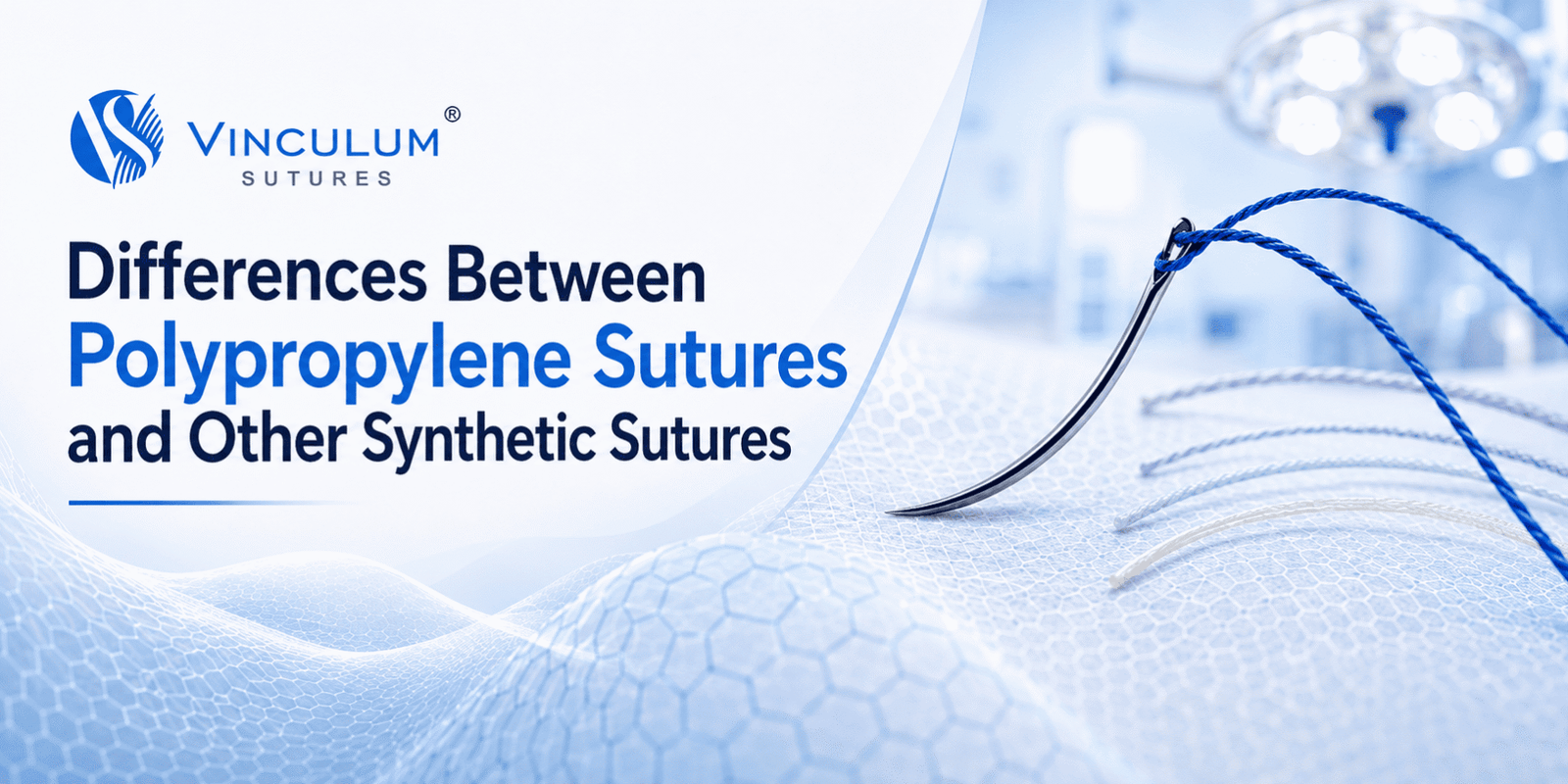
Polypropylene suture is a synthetic, non-absorbable surgical suture manufactured from a polyolefin polymer. It is typically supplied as a monofilament strand, meaning it consists of a single smooth filament rather than multiple braided fibres.
VINLENE Polypropylene Suture from Vinculum Sutures is a sterile monofilament suture designed for general soft-tissue approximation and ligation. It may be used in cardiovascular, ophthalmic, neurological, orthopaedic, gynaecological, endoscopic and general surgical procedures, along with skin closure, ligament repair and mesh fixation. (Vinculum Sutures)
The main characteristics of polypropylene include:
- Non-absorbable construction
- Smooth monofilament surface
- Long-term tissue support
- Low tissue reactivity
- Resistance to biological degradation
- Flexibility and controlled elasticity
- Reduced capillary action compared with braided sutures
Polypropylene Sutures vs Other Synthetic Sutures
The primary differences between polypropylene and other synthetic materials relate to absorption, filament structure, handling, tissue reaction, strength retention and clinical application.
1. Polypropylene vs Nylon Sutures
Polypropylene and nylon are both synthetic, non-absorbable sutures and are commonly available in monofilament form. However, their long-term behaviour and handling characteristics are different.
Strength Retention
Polypropylene is selected when prolonged or permanent tissue support is required. It is resistant to enzymatic degradation and generally retains its strength over an extended period.
Nylon is also classified as non-absorbable, but it may gradually lose tensile strength over several years because of slow hydrolytic degradation.
Handling and Memory
Nylon generally provides good tensile strength and elasticity, but monofilament nylon can have noticeable memory. This means it may attempt to return to its original packaged shape during handling.
Polypropylene can also exhibit memory and requires an appropriate knotting technique. Its smooth surface may require additional knot throws to maintain secure fixation.
Common Applications
Polypropylene is frequently selected for:
- Cardiovascular procedures
- Hernia mesh fixation
- Ligament repair
- General soft-tissue approximation
- Skin closure
- Procedures requiring long-term support
Nylon is commonly used for:
- Skin closure
- Plastic and reconstructive surgery
- Ophthalmic procedures
- Microsurgery
- General soft-tissue approximation
The choice depends on whether permanent strength, elasticity, removal characteristics or fine tissue handling is the primary requirement.
2. Polypropylene vs Polyester Sutures
Polypropylene and polyester are both synthetic, non-absorbable sutures, but their physical construction and handling profiles are substantially different.
Filament Structure
Polypropylene is normally a monofilament suture with a smooth surface.
Polyester is commonly manufactured as a braided multifilament suture composed of polyethylene terephthalate. Braiding improves flexibility and knot security but creates small spaces between the fibres.
Tissue Passage
The smooth monofilament surface of polypropylene supports relatively atraumatic tissue passage and reduced tissue drag.
Braided polyester may create more friction while passing through tissue, although coatings are often applied to improve smoothness and handling.
Knot Security
Polyester generally offers strong knot security because the braided strands create greater friction within the knot.
Polypropylene has a smoother surface and may require more precise knot placement and additional throws to prevent slippage.
Capillary Action and Contamination
Monofilament polypropylene has less capillary action than braided polyester. Multifilament sutures can retain more fluid between their fibres, which may be an important consideration in contaminated or infection-prone surgical sites.
Common Applications
Polypropylene is commonly used where smooth tissue passage and permanent support are important.
Polyester is often selected for:
- Cardiovascular surgery
- Tendon and ligament repair
- Orthopaedic procedures
- General soft-tissue approximation
- Procedures requiring strong knot security
Therefore, polypropylene may be preferred for minimal tissue interaction, while polyester may be selected when handling and knot-holding characteristics are particularly important.
3. Polypropylene vs Polydioxanone Sutures
Polypropylene and polydioxanone are both commonly available as synthetic monofilament sutures. Their most important difference is absorbability.
Absorption
Polypropylene is non-absorbable and remains in the tissue unless removed.
Polydioxanone is absorbable and gradually loses tensile strength before being absorbed through hydrolysis.
Duration of Support
Polypropylene provides prolonged or permanent mechanical support.
Polydioxanone provides extended temporary support and is generally selected for tissues that heal slowly but do not require a permanent implant.
Clinical Use
Polypropylene may be chosen for cardiovascular surgery, permanent fixation, ligament repair and other long-term applications.
Polydioxanone may be used for:
- Fascial closure
- Abdominal wall closure
- Paediatric surgery
- General soft-tissue approximation
- Procedures requiring extended absorbable support
Polydioxanone is more suitable when long-lasting but temporary support is needed, whereas polypropylene is appropriate when the support must remain indefinitely.
4. Polypropylene vs Polyglactin 910 Sutures
Polyglactin 910 differs from polypropylene in both absorbability and structure.
Structure
Polypropylene is generally monofilament.
Polyglactin 910 is usually a braided synthetic absorbable suture, although specialised versions may vary.
Handling
Braided polyglactin 910 is generally flexible and provides reliable handling and knot security.
Polypropylene has a smoother surface but may feel less pliable and may require careful knot management.
Tissue Interaction
Polypropylene produces a relatively limited tissue response and has reduced capillary action because of its monofilament structure.
Braided polyglactin 910 may produce more tissue friction and can retain fluid between its fibres. However, it is absorbed after fulfilling its temporary support function.
Applications
Polyglactin 910 is commonly selected for:
- Subcutaneous tissue closure
- Mucosal closure
- General soft-tissue approximation
- Gynaecological procedures
- Gastrointestinal surgery
Polypropylene is preferred when permanent strength and minimal degradation are required.
5. Polypropylene vs Polyglecaprone 25 Sutures
Polypropylene and polyglecaprone 25 are both synthetic monofilament sutures with smooth surfaces, but they serve different purposes.
Absorption Profile
Polypropylene is non-absorbable.
Polyglecaprone 25 is absorbable and is intended for tissues that require short- to medium-term wound support.
Handling
Polyglecaprone 25 is known for smooth passage through tissue and flexible handling. It is commonly chosen for subcuticular and cosmetic wound closure.
Polypropylene also passes smoothly through tissue but provides permanent rather than temporary support.
Typical Uses
Polyglecaprone 25 may be used for:
- Subcuticular skin closure
- Plastic and reconstructive procedures
- General soft-tissue approximation
- Wounds that heal within a predictable period
Polypropylene may be used where prolonged strength is required, particularly in cardiovascular, orthopaedic and fixation procedures.
6. Polypropylene vs Polyglycolic Acid Sutures
Polyglycolic acid, commonly known as PGA, is a synthetic absorbable braided suture.
Material Behaviour
Polypropylene retains its structure and support for the long term.
PGA gradually loses tensile strength and is absorbed through hydrolysis.
Surface and Handling
PGA’s braided structure generally provides good handling and knot security. However, it may create greater tissue drag than monofilament polypropylene.
Polypropylene offers smoother tissue passage and lower fluid movement through the suture strand.
Applications
PGA may be selected for internal tissues that heal within the suture’s absorption period, while polypropylene is chosen for permanent approximation or fixation.
Key Advantages of Polypropylene Sutures
Polypropylene offers several benefits that distinguish it from many other synthetic sutures.
Long-Term Strength
As a non-absorbable material, polypropylene is suitable for tissues requiring prolonged mechanical support.
Minimal Tissue Reactivity
Its chemically inert characteristics help reduce tissue reaction compared with more reactive suture materials.
Smooth Tissue Passage
The monofilament construction provides a uniform surface that can pass through tissue with relatively low drag.
Reduced Capillary Action
Unlike braided sutures, polypropylene does not contain multiple interwoven fibres through which fluid can travel easily.
Resistance to Degradation
Polypropylene is resistant to enzymatic breakdown and is not intended to undergo predictable absorption within the body.
Useful Elasticity
Its controlled elasticity allows the suture to accommodate limited tissue movement while maintaining approximation.
Limitations of Polypropylene Sutures
Despite its advantages, polypropylene is not suitable for every surgical situation.
Its smooth surface may provide lower knot friction than braided sutures, making secure knotting technique essential. Monofilament memory can also affect handling, especially in larger suture sizes.
Because it is non-absorbable, polypropylene may remain permanently in the body. It may therefore be inappropriate where permanent foreign material is unnecessary or where an absorbable closure is preferred.
The final selection should be based on the surgical site, required strength duration, wound condition and surgeon’s technique.
Quick Comparison of Synthetic Suture Materials
| Suture material | Absorbability | Common structure | Main characteristic |
|---|---|---|---|
| Polypropylene | Non-absorbable | Monofilament | Permanent support and low tissue reactivity |
| Nylon | Non-absorbable | Usually monofilament | Strong and commonly used for skin closure |
| Polyester | Non-absorbable | Usually braided | Excellent handling and knot security |
| Polydioxanone | Absorbable | Monofilament | Extended temporary wound support |
| Polyglactin 910 | Absorbable | Usually braided | Flexible handling and predictable absorption |
| Polyglecaprone 25 | Absorbable | Monofilament | Smooth handling for soft tissue and skin closure |
| PGA | Absorbable | Braided | Reliable temporary support and knot security |
Synthetic sutures are regulated according to their material, structure, absorbability and intended use. FDA guidance recognises both absorbable and non-absorbable synthetic sutures for soft-tissue approximation and ligation, including polypropylene, polyester, polyamide, polydioxanone and glycolide-based materials. (U.S. Food and Drug Administration)
How to Select the Right Synthetic Suture
Suture selection should consider:
- Tissue-healing speed
- Required support duration
- Wound tension
- Risk of infection or contamination
- Tissue sensitivity
- Monofilament or braided construction
- Knot security
- Needle type and size
- Surgical technique
- Whether permanent material is required
No single synthetic suture is ideal for every procedure. Mechanical studies also demonstrate that different suture materials vary in tensile strength, elongation and resistance to handling-related damage, reinforcing the need to match the material to the specific tissue and procedure.
VINLENE Polypropylene Suture by Vinculum Sutures
VINLENE from Vinculum Sutures is a sterile, synthetic, non-absorbable monofilament polypropylene surgical suture. Its smooth surface is designed to support controlled tissue passage, while its long-term strength makes it suitable for procedures requiring durable tissue approximation or ligation.
Its blue pigmentation improves visibility in the surgical field, and its monofilament structure helps minimise tissue drag and capillary action. VINLENE is available for a wide range of surgical applications, including cardiovascular, ophthalmic, neurological, orthopaedic, general, gynaecological and endoscopic procedures. (Vinculum Sutures)
Conclusion
The main difference between polypropylene and other synthetic sutures lies in its combination of non-absorbability, monofilament construction, chemical stability and long-term strength retention.
Compared with nylon, polypropylene offers more stable permanent support. Compared with polyester, it provides a smoother monofilament surface and reduced capillary action. Compared with absorbable synthetic sutures such as polydioxanone, polyglactin 910, polyglecaprone 25 and PGA, polypropylene remains within the tissue and continues to provide support beyond the normal healing period.
VINLENE Polypropylene Suture by Vinculum Sutures offers reliable performance for surgical procedures in which smooth tissue passage, minimal tissue interaction and durable wound support are important.